
Here is how we determine how our books are kept, borrowed, or saved for later.
Kept – Home Library
Our son has been gifted amazing books. Some are new and some are well loved hand-me-downs.
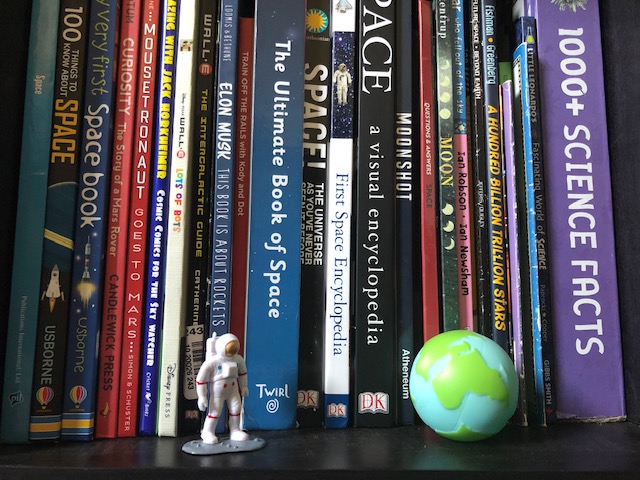
Suggestion #1: It is crucial for us is to keep the books where he can easily access them, or they can be forgotten. His books fill a floor level bookshelf with no doors so he can always see them. This bookshelf is in his room to keep down on books becoming floor tiles in the living room. We do have a bin of board books near his bed that are easy bedtime reads too.
Suggestion #2: We rotate books. No, we do not turn them pages out and binding in. We take a quarter of his books, and we put them in the closet or garage and switch them out every so often. This keeps his bookshelf exciting and fun.
Suggestion #3: If we notice that particular books are not getting read, loved, or appreciated we try to bring them out and reintroduce them. If he shows no interest, I put them aside and try again later. If you know your child does not care for a book and you do not either, consider donating the book to a family, friend, or a local donation spot. Someone else will love the books.
Borrowed – Public Library
My son wakes up asking if we can go to the library after school. Often, after school, he cannot imagine missing library time. I love the time we spend there so we have some tips to make the most out of your experience.
Suggestion #1: Check your local libraries online catalog when you see a book that your child would love. My library has a website where you can log-in, place a hold on books, and create a “Save for Later” bookshelf list. This is key. When you put books on hold it may take time for the books to be ready for pick up. Also, if the books sit too long at pick-up or are forgotten some libraries may charge you.
When you see your child fall in love with a library book, and it is almost painful for them to return it then you can consider buying the book.
Suggestion #2: Tour the whole library with your child. Seeing older children and adults reading, will model the appropriate behavior for the library setting. Then take your child down all of the aisles of books in the children’s area. Like at the grocery store, point out different areas like you would food. For example, “Oh, this is where the books about people are, like Elon Musk” or, “this section is non-fiction; that means they are true stories with facts.”
Suggestion #3: Embrace the children’s computers that are loaded with educational games. I would set a time limit though. We have a tablet at home, but not a family computer for our son to practice typing.
Suggestion #4: Once you are back home, keep a bin of the library books that are separate from your home library. We keep ours in the living room, so it is in eyesight. This encourages our son to read his new books and helps us keep track of books that need to be returned.
Sensory Processing Suggestion: If your child has sensory sensitivities like our son, consider going when it is not Read Aloud Story time or crowded with children. We always bring our sons ear defenders (semi noise-canceling headphones), and it makes a huge difference. We also sit in the pre-teen area because he is usually quiet and less distracting with movement and sound.
Saved – Adding to the Home Library
So, after we tried it and loved it we decided to buy it. But what do you do when you the book is not available at your local library?
Suggestion #1: We first check the library website to find a book. If it is not at our library or cannot be sent from one nearby, I check Amazon. Hear me out first before you jump to conclusions. I have found it very helpful to find the book on Amazon and save it to a special book list. This way when we are at a second-hand bookstore or an adorable mom and pop bookstore, I have my list of titles and authors. Having a digital list with a picture of the cover is super helpful.
Suggestion #2: One book in, one book out – sort of. In theory this sounds great. You just brought home a book to keep so one should be donated. If that works for you, great, and if not, great. However we have found that our ebb and flow is much more organic, that is sometimes when you move homes there is a much larger ebb.
Questions for you: What is your method for selecting books for your child? Do you keep a “Save for Later” list? Do you put books on hold at your library?
 The Boy Who Borrowed the Moon
Love your suggestions! We use the library to “teat drive” and we also try (and fail) at the one in / one out. Recently we’re trying a more soecific and intentional labeling system that I hope will help my kids understand nebulous concepts AND find their books. So for example we have one section of the shelf called Identity and Integrity. The other new thing is that I’ve begun taking out books that have misrepresentations of native Americans. So far we’ve only had to remove two.
LikeLiked by 1 person
Let me know how that goes. I don’t have a method for when we go to a new library, but that’s a great idea for a new blog entry. I’m also finding that there are some classics that aren’t accurate. My son loves book sales and secondhand books, unfortunately they are dated and not always correct. Luckily we can replace those inaccurate books with some diverse books that weren’t available before.
LikeLike
We absolutely make good use of placing hold requests in our local library system. We use Goodreads and Amazon for tracking books we want to save for reading later. As far as choosing books, sometimes she leads based on interest or one of us stumbles across something we think will broaden her horizons. Lots of library first, then purchase to keep in our house too! Also, we frequent used bookshops and enjoy the experience of discovering old books that are new to us.
LikeLike
I love this. Thank you for sharing your process. I’m going to look into Goodreads. ❤️
LikeLike